China Wholesale Prefab Modular Homes Supplier & Exporters

Global Engineering White Paper & B2B Procurement Intelligence: Turnkey Design, Precision Structural Steel Fabrication, Thermal Envelope Technologies, and Scalable Volumetric Export Logistics.

Export-Grade Product Matrix

Featured Industrial & Prefabricated Modular Structures

Standardized engineering precision manufactured to BS EN 1090, AWS D1.1, and GB/T 50205 standards. High intermodal packing efficiency, rapid site erection, and rigorous multi-climate weatherability.

2010
Established Engineering Heritage
352+
Global Projects Handed Over
100+
In-House Engineers & Specialists
120+
Institutional & EPC Clients
Enterprise Competency

Why Institutional Buyers Partner with Our Manufacturing Hub

Eliminating sub-contractor friction through an end-to-end single-contract methodology spanning structural structural engineering, automated rolling, sandwich panel chemistry, and international turnkey execution.

End-to-End Vertical Manufacturing

We execute design, primary/secondary steel fabrication, plate processing, profile cold-forming, continuous sandwich panel foaming, and automated coil coloring within our self-owned production complexes. Zero intermediate contractor margin compounding.

BIM Level 3 & DfMA Engineering

Every connection node, anchor base, and cold-formed member is modeled in Tekla Structures and PKPM with clash-detection analysis down to 0.5mm tolerances. Shop drawings translate seamlessly to CNC beamlines, punching, and plasma tables.

Advanced Core Chemistry: EPS, PU & Rockwool

In-house continuous production lines for Expanded Polystyrene (EPS), high-density closed-cell Polyurethane (PU/PIR, 40-45kg/m³), and basalt-based non-combustible Rockwool panels (100-140kg/m³), meeting rigorous international building and fire codes.

Turnkey Civil & RCC Substructure Capability

Unlike brokers who supply loose steel without structural accountability, our engineering divisions deliver integrated foundation design, anchor bolt pre-setting cages, floor slab RCC integrations, and on-site technical erection supervision worldwide.

Proven Export Logistics to 30+ Nations

Engineered bundling algorithms designed for standard 40ft High Cube intermodal marine containers and break-bulk freighters. Each member features rust-resistant coding, barcoded manifests, and sea-worthy moisture barrier shrink packaging.

Rigorous QA/QC & Third-Party Testing

Certified welding procedures compliant with AWS D1.1 and EN ISO 3834. Ultrasonic non-destructive testing (UT) on butt welds, magnetic particle testing (MT), paint dry film thickness (DFT) gauges, and tensile yield tests conducted for every raw coil heat number.

Procurement Intelligence

Future Procurement Trends in the Global Modular & Prefab Market

Shifting procurement dynamics from initial capital expenditure (CapEx) to Life Cycle Costing (LCC), supply chain decarbonization, and intermodal transport footprint reduction.

1. Shift from Volumetric Shipping to Hybrid Flat-Packing

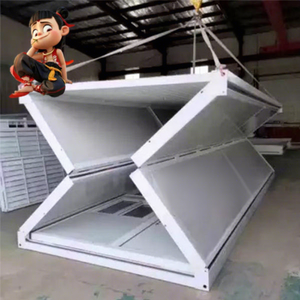
With unpredictable ocean freight volatility, international developers are abandoning pre-assembled rigid box volumes that ship 80% empty air. Future sourcing mandates high-nesting flat-pack frameworks where four fully insulated habitable modules pack into the cubic volume of a single standard 40ft shipping container, slashing maritime transport costs by up to 72%.

2. Stringent Thermal Envelope & Life-Cycle Decarbonization

Procurement contracts across North America, Europe, and Australasia now enforce rigorous U-values below 0.22 W/m²K. Buyers demand third-party Environmental Product Declarations (EPDs), transitioning from standard EPS to ozone-depleting-substance-free (ODS-free) Polyisocyanurate (PIR) and recycled slag mineral wool to lower embodied carbon indices.

3. Plug-and-Play MEP Sub-System Integration

The next decade belongs to prefabricated infrastructure with pre-installed, factory-certified Mechanical, Electrical, and Plumbing (MEP) routes. Conduit chases, quick-connect plumbing manifolds, and low-voltage automation loops are sealed within the floor cassettes and composite walls during factory assembly, reducing expensive on-site trades by 65%.

4. Circular Deconstructability & Asset Relocatability

Mining operators, civil infrastructure consortia, and defense contractors increasingly structure procurement contracts around residual asset recovery. High-value procurement specifications mandate 100% bolted structural node connectivity, allowing buildings to be disassembled, packed, and redeployed up to 10 times over a 25-year operational lifecycle without structural fatigue.

5. Digital Twin Verification Pre-Shipment

Global EPCs are removing physical factory inspection travel costs through cloud-synced digital twins. Fabricated components are laser-scanned at the workshop floor against the Tekla LOD 400 design file. Any deviation beyond 1mm is corrected prior to anti-corrosive coating, ensuring zero weld alterations or re-drilling during international site assembly.

6. Hybrid Heavy PEB & Modular Living Interlocks

Large-scale industrial sites no longer separate operational factories from administrative housing. Progressive sourcing combines primary structural PEB frames (spanning 30m+ for industrial warehousing) with integrated two-story modular container offices, creating unified architectural shells with optimized thermal performance and cohesive structural warranties.

Engineering White Paper

Technological Innovations Driving Prefab Modular Evolution

A deep technical analysis of metallurgy, robotic automated cold-forming, composite thermodynamics, and advanced corrosion science reshaping modular manufacturing.

Automated High-Frequency Laser & Submerged Arc Welding

Modern prefabricated modular frames have moved beyond legacy manual stick welding. Modern manufacturing leverages automated 6-axis robotic welding cells and continuous submerged arc welding (SAW) for H-beam fabrication. This guarantees complete joint penetration (CJP), eliminates slag inclusions, and delivers consistent weld throats capable of withstanding dynamic lateral cyclic loads during seismic events (Richter Magnitude 8.0+ / Seismic Zone 4 compliance).

Continuous Polymer Foam & Basalt Core Lamination

Sandwich panel integrity relies heavily on bond shear strength between the metal skin and the core. Advanced continuous laminators use multi-component high-pressure polyol and isocyanate impingement mixing systems, achieving consistent core densities of 42 kg/m³ with closed-cell ratios exceeding 95%. For non-combustible panels, oriented perpendicular basalt mineral fibers achieve high compressive load-bearing capability while preserving 2-hour fire endurance ratings (EN 13501-1 Class A1).

Multi-Layer Anti-Corrosion Metallurgy (ISO 12944 C4/C5-M)

Marine atmosphere, industrial mining, and chemical processing installations degrade inferior steel within 24 months. State-of-the-art export modules undergo Sa 2.5 shot blasting to remove mill scale, followed by a hot-dip galvanization coating (minimum 275 g/m² zinc layer) or a three-tier system: zinc-rich epoxy primer (80μm), epoxy micaceous iron oxide intermediate (100μm), and an aliphatic polyurethane topcoat (70μm) providing 25+ years of zero-maintenance surface protection.

Cold-Bridge Elimination & Aerogel Perimeter Gaskets

Traditional steel modular containers suffered from internal condensation and thermal short-circuiting where internal steel members contacted the exterior skin. Advanced modular manufacturing embeds high-density structural polyamide thermal break strips, closed-cell EPDM perimeter gaskets, and aerogel insulation blankets at all corner castings and perimeter flange joints, reducing interstitial moisture risks and HVAC energy loads by over 40%.

Technical Comparison: Prefabricated Systems vs. Traditional Construction

Evaluation Parameter Modular Flat-Pack System Pre-Engineered Building (PEB) Light Gauge Steel (LGS) In-Situ Concrete / RCC
Erection Speed (sqm/day/crew) 150 – 250 m² 80 – 150 m² 50 – 100 m² 15 – 30 m²
Structural Dead Weight (kN/m²) 0.25 – 0.40 0.30 – 0.60 0.20 – 0.35 2.20 – 3.50
Thermal Transmittance (U-Value) 0.18 – 0.28 W/m²K 0.22 – 0.32 W/m²K 0.20 – 0.30 W/m²K 0.85 – 1.40 W/m²K
Seismic Damping Ratio High (> 5% ductile) Moderate to High Moderate Low (Brittle drift risk)
Embodied Carbon (kg CO₂e/m²) 180 – 240 220 – 290 200 – 260 450 – 620
Relocatability & Salvage Index 95% Salvageable 75% Reconfigurable 60% Salvageable 0% (Demolition waste)
Material Selection Guide

Matching Modular Envelopes to Environmental Rigors

Procurement specifications must match environmental exposure, fire authority requirements, and thermal targets. Review our core comparative criteria below.

Expanded Polystyrene (EPS)

Density: 12 – 18 kg/m³
Thermal Conductivity (λ): 0.038 W/m·K
Fire Behavior: Self-extinguishing B1 grade available
Core Advantage: Most economical cost-per-square-meter; lightweight for rapid manual handling. Ideal for worker camps, site administration units, and standard temp-storage sheds.

Polyurethane / Polyisocyanurate (PU/PIR)

Density: 40 – 45 kg/m³
Thermal Conductivity (λ): 0.022 W/m·K
Fire Behavior: PIR B1 fire-retardant (Low smoke emissions)
Core Advantage: Superior thermal insulation per unit thickness, zero air permeability. Mandatory for cold-chain pharmaceutical warehousing, cold rooms, and extreme polar/desert climates.

Structural Rock Wool (Mineral Wool)

Density: 100 – 140 kg/m³
Thermal Conductivity (λ): 0.044 W/m·K
Fire Behavior: Non-combustible Class A1 (120-180 min fire rating)
Core Advantage: Fire safety compliance and acoustic dampening. Specified for transformer buildings, power stations, urban commercial residential hubs, and strict municipal fire codes.

Technical FAQs

B2B Procurement & Engineering Inquiry FAQ

Definitive answers covering customs clearance compliance, structural load tolerances, intermodal shipping manifests, and site foundation interfacing.

What structural engineering design codes do your modular buildings and PEB factories follow?

Our engineering division models all structures according to destination project jurisdictions. We routinely engineer and deliver to American Standards (AISC 360 for structural steel, AISI S100 for cold-formed steel, ASCE 7 for minimum design loads), Eurocodes (EN 1993 for steel design, EN 1090 structural fabrication conformity), Australian/New Zealand Standards (AS/NZS 4100 and AS/NZS 4600), and Chinese National Standards (GB 50017, GB 50009). Every international shipment includes fully stamped static calculation sheets, connection verification models, and raw material heat certificates.

How are wind load, snow load, and seismic drift calculated for international projects?

During the design phase, our engineers input your project's specific GPS coordinates into computational modeling software to account for local terrain roughness (Exposure Category B, C, or D). Our standard export modular containers are rated for 3-second wind gusts up to 210 km/h (expandable to 260 km/h for cyclone-prone tropical coastlines) and ground snow loads up to 2.5 kN/m². For seismic zones, the connection brackets are engineered with ductile moment-resisting gusset assemblies calibrated to survive Spectral Acceleration parameters (Ss, S1) corresponding to Richter Magnitude 8.0+ tremors.

What is the shipping packaging density for flat-pack container houses in standard marine containers?

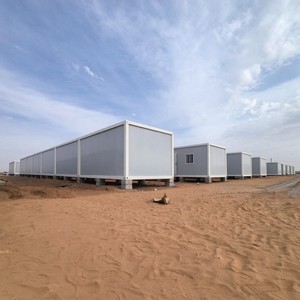
Our flat-pack systems are engineered precisely around intermodal shipping economics. A standard 20ft modular flat-pack unit measures 6055mm (L) x 2438mm (W) x 580mm (H) in its compressed package. This profile allows four (4) fully self-contained habitable flat-pack units (including insulated roof, structural floor chassis, corner columns, door/window joinery, and 14 sandwich wall panels) to be interlocked into an ISO-certified shipping container bundle with CSC certification, or nested tightly inside a standard 40ft High Cube (40HQ) marine shipping container. This logistics optimization cuts maritime freight costs by 70-75% compared to shipping rigid volumetric assembled units.

Can your company integrate complete civil, foundation, and RCC work under a single turnkey contract?

Yes. Operating continuously since 2010 with more than 352 completed industrial projects, Joint Star provides full turnkey engineering packages that encompass geotechnical structural coordination, foundation anchor bolt cage supply, reinforced cement concrete (RCC) design optimization, site casting coordination, and superstructure erection. This unified turnkey delivery eliminates the common interface clashes between civil contractors and pre-engineered steel fabricators, saving weeks in schedule alignment and mitigating costly foundation mismatch liabilities.

What testing and documentation are supplied for customs clearance and quality verification?

Every commercial wholesale export consignment is accompanied by a Quality Dossier comprising: Mill Test Certificates (MTC EN 10204 3.1) verifying steel yield and tensile strength, Ultrasonic Testing (UT) inspection logs for CJP welds, Coating Thickness Reports verifying Dry Film Thickness (DFT), Sandwich Panel Flame Spread Index certificates, Certificate of Origin (Form E, Form A, or RCEP for tariff reduction), and detailed 3D step-by-step erection manuals with numbered structural member tags corresponding 1:1 with packing manifests.

What is the life expectancy and warranty coverage for your wholesale modular buildings?

The primary load-bearing structural steel frame (Q235B/Q355B hot-dip galvanized or epoxy coated) possesses an engineered design life of 50+ years. The insulated composite sandwich roof and wall panels carry an operational life expectancy of 25 to 30 years under normal environmental conditions. We provide a comprehensive 10-year warranty on primary structural steel integrity and a 5-year warranty on coil coating weatherability (anti-peeling, anti-chalking, and anti-corrosion), backed by our engineering service teams.

Initiate Your Structural Consultation & Wholesale RFQ

Whether you are tendering for a 500-unit mining accommodation village, a multi-story modular healthcare center, or a 20,000 sqm clear-span logistics hub, our engineering directors are on standby to develop preliminary structural models, load analyses, and FOB/CIF budget quotations.