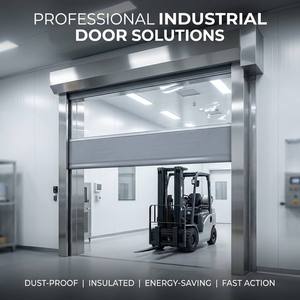
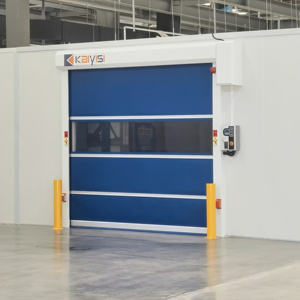
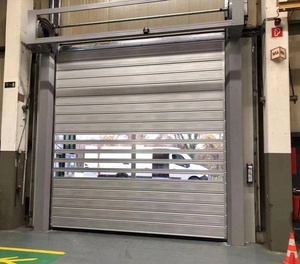
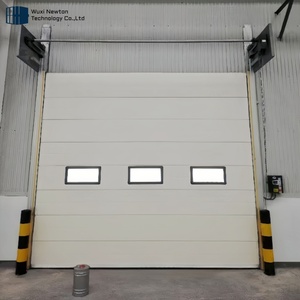
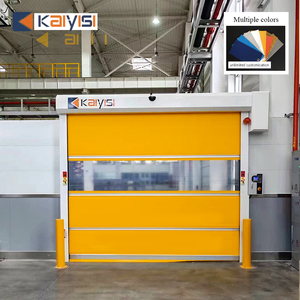
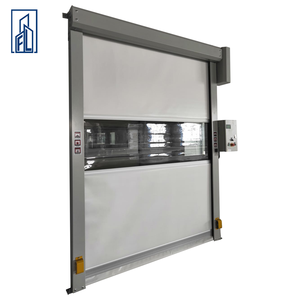
Automatic SUS304 High Speed Door Fast Moving PVC Roller Door for Modern Logistics and Supermarkets
- Chassis Material:SUS304 Stainless
- Opening Velocity:Up to 2.0 m/s
- Curtain Gauge:0.9mm - 1.2mm PVC
- Drive System:Servo Frequency Drive
Precision-manufactured in China under ISO 9001 and CE EN 13241-1 quality control protocols. High-cycle duty, active hermetic sealing, and seamless PLC/inverter automation for intensive logistics environments.
Global Industrial Projects Delivered
Direct B2B Multinational Clients
In-House Engineers & Fabricators
Years Continuous Export Heritage
In contrast to assembly workshops that re-label generic components, our precision plants control the complete value loop: in-house CNC sheet metal stamping, automated laser cutting of SUS304 frames, automated PU core foaming, and dedicated firmware matching for dynamic servo controllers.
We manufacture both the cold-roll-formed structural guide rails and the precision drive control software under one roof. This turnkey design architecture prevents the communication latency, mechanical gear slippage, and premature wear typical of multi-vendor assemblies.
Our rapid doors carry comprehensive European Conformity (CE) certifications meeting Machinery Directive 2006/42/EC and EN 13241-1. We guarantee wind-load verification according to EN 12424 Class 3 to Class 4 and cleanroom air-permeability standards under EN 12426.
Export components are packed in fumigated reinforced timber crates with custom anti-abrasion foam interlayers, vacuum-sealed electronic desiccants, and barcoded modular labels to facilitate damage-free ocean freight and swift site erection across EMEA, APAC, and the Americas.
Selecting the appropriate door typology requires balancing velocity, thermal boundary decoupling, wind load ratings, and sanitary compliance. Consult the engineering comparison matrix below.
| Parametric Criteria | Rigid Spiral Turbo Door | High-Speed Flexible PVC Door | Cleanroom Air-Tight Roll Up | Heavy Sectional Dock Gate |
|---|---|---|---|---|
| Max Opening Speed | 1.5 - 2.5 m/s | 0.8 - 2.0 m/s | 1.0 - 1.8 m/s | 0.25 - 0.4 m/s |
| Curtain / Panel Material | 0.8-2.0mm Double Al-Alloy + PU | 0.9mm - 1.5mm High-Tear PVC | Non-Static B1 Anti-Microbial PVC | 40mm-50mm Steel Sandwich Panel |
| Wind Resistance (EN 12424) | Class 4 (Up to 133 km/h Hurricane) | Class 2 - Class 3 with wind ribs | Class 1 - Class 2 (Indoor Differential) | Class 3 (Sustained Perimeter Load) |
| Sealing / Permeability | EPDM Dual-Lip Vertical Track Seal | High-Density Nylon Brush Strip | Hermetic Zipper Continuous Track | Perimeter EPDM Weather-stripping |
| Thermal Transmittance (U) | 1.2 - 1.5 W/(m²·K) (Thermal Break) | ~5.6 W/(m²·K) (Single Layer) | ~4.8 W/(m²·K) (Air Pocket Option) | 0.8 - 1.1 W/(m²·K) (Rigid Polyurethane) |
| Design Lifetime Cycle Rating | 2,500,000 Operations | 1,500,000 Operations | 1,800,000 Operations | 100,000 - 250,000 Operations |
| Recommended Facility Zones | External Security, Automotive, Logistics | High-Traffic Warehouses, Supermarkets | Pharma, Biotechnology, Semi-Conductor | Heavy Logistics Docks, Cargo Depots |
Industrial door systems are evolving from passive site enclosures into mission-critical, data-integrated automation nodes. International buyers must integrate the following macroeconomic and technological vectors into their 5-year specifications.
Next-generation fast-speed doors deployed in automated factories utilize smart inverters equipped with onboard CAN-bus, Modbus TCP, or Profinet protocols. Real-time telemetry tracks torque variations, cycle counts, motor coil temperatures, and brake pad wear, transmitting preventative maintenance alarms before catastrophic microswitch or bearing failure occurs.
Rising energy costs and corporate carbon taxation are accelerating the replacement of standard industrial rolling shutters with rapid-cycling insulated spiral systems. High-velocity cycle times (opening at 2.5 m/s and closing in under 3 seconds) reduce the open-door convective air exchange by up to 82%, cutting HVAC and refrigeration energy expenditures by thousands of dollars per bay annually.
Accidental forklift collisions remain the leading cause of door downtime in distribution centers. The procurement trend is pivoting decisively away from rigid bottom aluminum bars toward flexible, zipper-guided curtains. Upon impact, the flexible curtain automatically unzips from its track and re-inserts itself during the subsequent ascending cycle, eliminating emergency technician callout fees.
Procuring fast-speed doors strictly on the lowest FOB purchase price is an expensive mistake. The initial acquisition cost accounts for less than 20% of an industrial door's 10-year lifecycle expense. Energy leakage through low-insulation curtains, motor burnouts caused by undersized frequency convertors, and downtime from mechanical cable failures quickly exceed initial savings.
Authoritative technical answers to assist project directors, MEP consultants, and international distribution buyers in evaluating Chinese rapid door manufacturers.
The distinction lies in cycle rating, motor drive engineering, and kinematics. Traditional roller shutters operate via standard AC induction worm gearboxes at 0.15–0.2 m/s, designed for 10–20 daily security cycles. In contrast, fast speed doors utilize brushless servo systems or frequency-inverter AC drives capable of 0.8 to 2.5 m/s speeds with a 100% duty cycle rating (1,000 to 2,500 daily operations).
Furthermore, fast doors incorporate non-contact spiral guides or low-friction zipper tracks that prevent mechanical abrasion of the curtain, ensuring operating lifespans exceeding 1,500,000 cycles without structural failure.

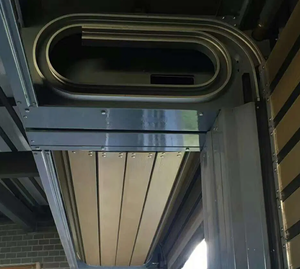
For high-wind coastal or exterior logistics bays, our engineering team deploys our rigid Aluminum Alloy Spiral Hard Door series or Heavy-Duty Reinforced PVC Doors. Our spiral doors feature double-walled 0.8mm–2.0mm aluminum slats filled with dense polyurethane foam (density 45 kg/m³) guided along circular non-contact tracks, achieving wind load resistance up to EN 12424 Class 4 (resisting up to 133 km/h hurricane-force winds).
For flexible PVC doors, high-tensile extruded anodized aluminum wind-reinforcement ribs are inserted into thermal-welded curtain pockets at calibrated 600mm–800mm intervals to distribute lateral pressure across the heavy-gauge guide columns.
Personnel safety is governed by EN 12453 / EN 12445 standards. Every industrial door dispatched from our export facilities includes three redundant safety layers:
1) Multi-Beam Infrared Light Curtains: An array of optoelectronic sensors casting up to 32 parallel beams across the opening height from 100mm to 1800mm, immediately stopping and reversing curtain travel if interrupted.
2) Wireless Anti-Pinch Safety Edge: A pneumatic or resistive conductive rubber edge along the bottom seal that triggers instant reversal upon contact pressure under 150 N.
3) Manual Emergency Counterbalance Release: A mechanical lever or counterweight spring system enabling one-handed manual door opening during catastrophic facility power failure.
Yes. Our industrial controllers are built on open-architecture PLCs featuring configurable digital I/O, dry-contact relays, and standard industrial fieldbus interfaces (RS485, Modbus, Profibus). We routinely supply customized automated doors for high-throughput automated guided vehicle (AGV) routes, robotics palletizing enclosures, and cross-dock conveyor systems.
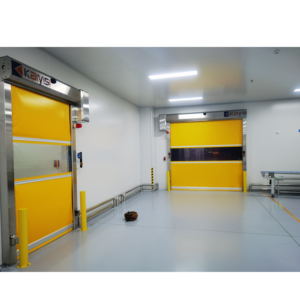
Interlocking programs allow sequential dual-door airlock operation, where Door B cannot activate until Door A is 100% seated and latched, maintaining cleanroom pressure differentials or cold-chain integrity.
In sterile environments, material selection and pressure tightness are paramount. Our cleanroom models utilize 304 or 316 grade stainless steel chassis with sloping header covers to prevent particulate accumulation and withstand aggressive chemical washdowns. The PVC fabric is anti-static, anti-microbial, and compliant with FDA/GMP sanitary standards.
Specialized zipper tracks form an airtight seal certified up to 50 Pa pressure differential according to EN 12426, mitigating air leakage, particulate infiltration, and cross-contamination between hygiene zones.
Standard export orders are fabricated within 10 to 18 business days following engineering shop-drawing approval. Prior to container dispatch, every door undergoes our 50-cycle Factory Acceptance Test (FAT), validating motor current draw, dynamic brake torque, photocell alignment, optical radar response, and emergency manual release functionality.
Comprehensive FAT documentation, high-resolution test video records, wiring schematics, and English installation manuals are provided to the procurement client alongside the bill of lading.
Connect with our senior technical engineering team for complete structural calculations, CAD layout integration, and wholesale factory pricing. We provide turn-key export logistics, tailored OEM/ODM branding, and verified lifecycle cost optimizations for industrial developers, general contractors, and automated facility integrators worldwide.