Heavy Industrial
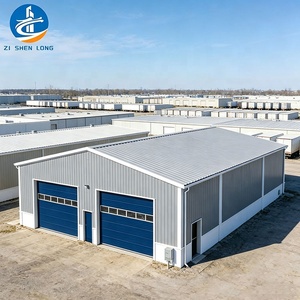
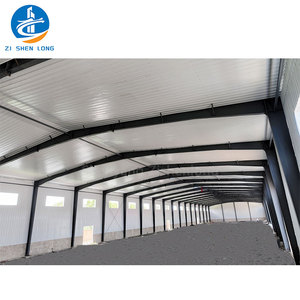
Steel Structure Factory Building Prefab Warehouse Commercial Office Hangar
- Clear-span portal frame up to 60m
- Primary grade Q355B high-tensile steel

Engineered in compliance with ISO9001, AWS D1.1, and EN1090 standards. Each structural configuration is custom-modeled in Tekla Structures, pre-fitted at the workshop, and shipped with comprehensive member tags and erection schematics.
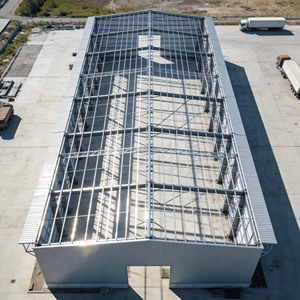
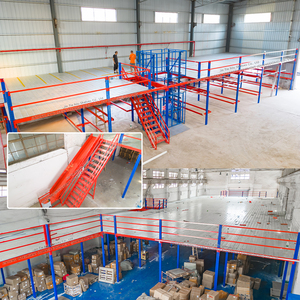
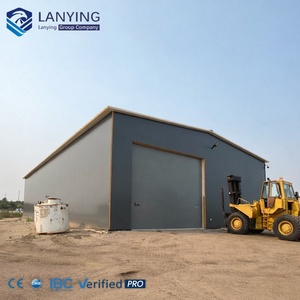
Understanding why international EPC general contractors and industrial developers source structural steel from China: an in-depth analysis of metallurgical chemistry, automated submerged arc welding, and finite element optimization.
Modern steel warehouse design utilizes tapered, variable-depth built-up H-sections engineered to match the bending moment diagram of portal frames. In high-span industrial facilities (30m to 60m clear spans without intermediate columns), maximum bending stress occurs at the eave-knee joints, while mid-span moments decrease significantly. By tapering primary rafter depths from 1200mm at the haunch down to 450mm at the ridge, Chinese fabrication hubs reduce non-structural dead weight by up to 22% compared to standard hot-rolled universal beams.
Primary materials conform strictly to Chinese National Standard GB/T 1591 Q355B / Q355C / Q355D (chemically and mechanically equivalent to EN 10025 S355JR and ASTM A572 Grade 50), offering a guaranteed minimum yield strength of 355 MPa. For seismic-critical applications in sub-zero operational environments (such as cold logistics or high-latitude regions), Q355D/E materials undergo Charpy V-notch impact toughness testing at -20°C to -40°C, verifying an absorbed energy threshold of ≥34 Joules to prevent catastrophic brittle fracture.
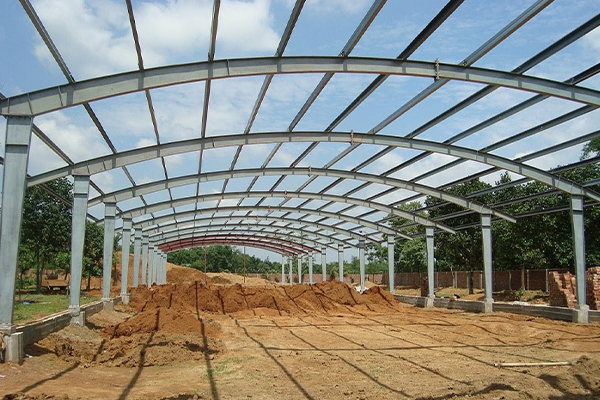
Secondary purlin systems act as critical lateral bracing for the compression flanges of main frame rafters. Continuous overlapping Z-purlins roll-formed from high-yield galvanized steel strip (min. 345 MPa to 450 MPa yield, zinc mass Z275 / 275g/m²) create structural continuity over intermediate portal bents. Lap ratios of 0.10L to 0.15L at negative moment supports maximize load redistribution, allowing purlin depth reductions and extended bay spacing up to 9.0 meters.
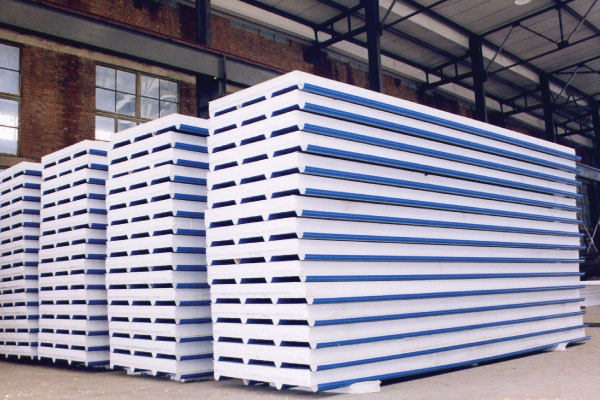
For wall and roof envelopes, procurement teams balance thermal efficiency against fire safety codes. Polyisocyanurate (PIR) cores offer an exceptional thermal conductivity of λ = 0.022 W/(m·K), making them the prime choice for climate-controlled logistics hubs. In contrast, basalt rock wool sandwich panels (bulk density 100–140 kg/m³) achieve an A1 non-combustible rating with up to 4 hours of certified fire resistance (EN 13501-2), safeguarding critical chemical and industrial production assets without toxic gas emission under flashover conditions.
| Structural Parameter | Light Prefab PEB Warehouse | Heavy Logistics / E-Commerce Hub | Crane-Equipped Heavy Workshop | Standards & Testing Reference |
|---|---|---|---|---|
| Primary Steel Grade | Q235B (Yield ≥235 MPa) | Q355B / Q355C (Yield ≥355 MPa) | Q355D / Q420B High Alloy | GB/T 1591 / ASTM A572 / EN 10025 |
| Clear Span Capability | 12m – 24m (Portal Bent) | 24m – 48m (Clear Open Floor) | Up to 60m (Multi-span with bays) | Finite Element Analysis (SAP2000) |
| Crane Hoisting System | None or Light Monorail (≤3T) | Overhead Underhung Crane (≤10T) | Double-Girder Bridge Crane (10T–50T) | GB/T 3811 / FEM Crane Design Code |
| Wind Load Resistance | 0.45 – 0.60 kN/m² (~120 km/h) | 0.70 – 0.95 kN/m² (~160 km/h) | ≥1.20 kN/m² (Category 4 Typhoon) | AS/NZS 1170.2 / ASCE 7-22 / GB 50009 |
| Anti-Corrosion System | Alkyd Primer + Topcoat (80μm) | Epoxy Zinc-Rich + Polyurethane (120μm) | Hot-Dip Galvanizing (HDG ≥85μm / 600g/m²) | ISO 12944 (C3, C4, C5-M Coastal Marine) |
| NDT Weld Inspection | Visual (VT) + 10% Ultrasonic (UT) | 100% VT + 20% UT on Butt Welds | 100% Full Penetration UT + MT Radiography | AWS D1.1 / EN ISO 17640 / GB 50205 |
How global procurement executives, real estate investment trusts (REITs), and industrial developers are navigating technological transformations, carbon border adjustments, and supply chain digitizations.
Procurement contracts increasingly mandate direct integration between Building Information Modeling (Tekla LOD 400) and automated multi-spindle drilling, plasma copers, and robotic welding lines. Eliminating manual paper conversions removes dimensioning human error, achieving hole pitch tolerances within ±0.5mm and ensuring 100% bolt-together site alignment without on-site reaming or torch cutting.
With the European Union CBAM (Carbon Border Adjustment Mechanism) and global ESG investment mandates in full swing, Tier-1 Chinese steel manufacturers are shifting primary structural production toward Electric Arc Furnaces (EAF) utilizing scrap steel and green hydrogen reduction. Verified Environmental Product Declarations (EPDs) are rapidly becoming standard RFP prerequisites for warehouse imports.
Future-proof warehouse procurement now routinely includes designated rooftop dead loads (0.25–0.35 kN/m²) specifically reserved for commercial photovoltaic (PV) solar panel arrays and battery energy storage systems (BESS). Structural purlins, roof rafters, and bracing systems are analyzed during the initial tender phase to support clean energy retrofits over the 50-year design lifecycle.
Freight volatility has elevated 3D container stowage optimization into an engineering discipline. Fabricators bundle primary H-beams inside 40ft High Cube and Open Top containers using custom steel dunnage to maximize tonnage without exceeding harbor limits. Every fabricated member receives a laser-etched weather-proof QR/RFID tag mapped directly to the 3D site erection sequence.
Direct factory sourcing eliminates broker markups while securing single-point engineering accountability from the foundation anchor bolt setting to the ridge ventilator cap.
We bridge the critical gap between substructure civil works and superstructure erection. By supplying complete anchor bolt cages, embedded baseplates, structural steelwork, sandwich envelope panels, and industrial sectional overhead doors under one commercial warranty, we eliminate blame-shifting between civil concrete contractors and steel frame erectors.
Quality is proven with documentation, not promises. Our factory houses internal spectral chemical analyzers, hydraulic tensile testing machines, metallurgical microscopes, and calibrated ultrasonic flaw detectors (UT). Buyers receive comprehensive Mill Test Certificates (MTC EN 10204 3.1) and third-party inspection dossiers (SGS, BV, Intertek, TUV) with every shipment.
We don't simply drop containers at your port of destination. We deploy seasoned bilingual site erection directors and certified crane rigging foremen directly to customer project locations across Southeast Asia, Africa, South America, and the Middle East to guide local construction labor, certify torque bolt tightening, and oversee precise envelope weather-proofing.
Straightforward answers addressing design approvals, international building codes, shipping container loading limits, foundation tolerances, and payment security.
Our senior structural engineering division utilizes licensed international design software suites including STAAD.Pro, ETABS, and Tekla Structures configured with custom regional design modules. For North American projects, we design according to the International Building Code (IBC 2024), AISC 360-16 (Specification for Structural Steel Buildings), and AISI S100 for cold-formed steel. For European and British Commonwealth destinations, calculations adhere to Eurocode 3 (EN 1993) and AS/NZS 1170. We output bilingual structural calculation books stamped with all dead loads, collateral ceiling loads, wind overturning pressures, and spectral seismic coefficients, allowing local registered professional engineers (PE) to review and secure municipal building permits seamlessly.
To avoid over-designing or inaccurate tonnage estimation, please provide: (1) Building Dimensions: Length × Width (clear span) × Eave Height and desired roof slope (typically 1:10 or 1:20); (2) Environmental Loadings: Maximum site wind speed (km/h or m/s), basic ground snow load (kN/m²), and seismic design category / ground acceleration; (3) Operational Machinery: Overhead bridge crane capacity (e.g., 5T, 10T, 20T), hook lifting height, and operating rail run length; (4) Envelope Requirements: Single corrugated color steel sheet (with or without fiberglass wool roll insulation blanket) versus sandwich panels (EPS, Polyurethane PIR, or Rockwool) along with desired core thickness (50mm, 75mm, 100mm, 150mm); (5) Doors & Fenestration: Electric industrial rolling doors, aluminum sliding windows, and clear skylight area percentages.
Selection depends strictly on budget, thermal performance, and local insurance/fire regulations:
• Expanded Polystyrene (EPS): The most budget-conscious, ultra-lightweight option. Best for dry bulk storage, standard machine workshops, and site construction camps where fire ratings are not heavily enforced.
• Polyisocyanurate (PIR / PU): Offers the highest thermal insulation per millimeter (λ ≈ 0.022 W/m·K). PIR has self-extinguishing fire performance (B1 fire class) and closed-cell density that prevents moisture absorption, making it the premier choice for cold-chain facilities, pharmaceuticals, and automated food processing facilities.
• Basalt Rockwool: Class A1 non-combustible material (melts at >1000°C). Specifically required for hazardous chemical storage, battery assembly factories, high-density distribution warehouses with strict municipal fire clearance, and installations requiring superior acoustic sound absorption.
Ocean freight represents a major cost driver in international procurement. We optimize freight through precise 3D volumetric software nesting. Heavy primary members (columns, crane girders, rafters) are bundled onto custom structural steel sleds that slide directly into 40ft High Cube (40'HQ) or 40ft Open Top (40'OT) containers. Delicate secondary cold-formed purlins are nested inside larger flange profiles. All machined flange connection surfaces, bolt holes, and anchor bolts are wrapped with protective geotextile foam and anti-rust greases. Fasteners and hardware are crated in seaworthy fumigated wooden boxes, ensuring your steel arrives free of saltwater corrosion, flange deformation, or transport abrasions.
For standard inland dry warehouses (ISO 12944 Corrosivity Category C2), a standard two-pack epoxy zinc-phosphate primer with an alkyd/polyurethane topcoat (total DFT 80–100μm) is sufficient. However, for coastal ports, chemical manufacturing zones, or marine environments (Category C4 or C5-M), we recommend either: (1) Hot-Dip Galvanizing (HDG) in accordance with ASTM A123 / ISO 1461, achieving a minimum zinc coating thickness of 85μm (600g/m²); or (2) A High-Performance 3-Coat Paint System comprising an inorganic zinc-rich primer (75μm DFT), an epoxy micaceous iron oxide (MIO) intermediate tie-coat (100μm DFT), and an aliphatic polyurethane topcoat (50μm DFT) yielding over 25 years of maintenance-free service life.
Yes. 100% of our pre-engineered steel warehouses are designed as prefabricated, full bolt-together systems. All hot-cutting, multi-pass submerged arc welding, plate punching, and bevel preparation are performed strictly in our climate-controlled factory prior to shipment. On-site erection crews require only mobile cranes, scissor lifts, spud wrenches, and calibrated electric torque multipliers to assemble ASTM A325 / Grade 8.8 and Grade 10.9 high-strength tension control friction-grip bolts. Zero on-site structural welding is required, dramatically accelerating completion schedules and reducing expensive field inspection liabilities.
Connect directly with our senior structural detailing team. Receive initial Tekla 3D structural layouts, optimized steel tonnage calculations, and full landed ocean CIF/DDP cost projections within 24 business hours.